Introduction
‘How can we stop migrants from working’ one of the judges on the bench commented as the Supreme Court on May 15 2020, declined to entertain an application to identify impotent migrant workers, take care of their needs and provide free transport to them. As a budding lawyer, the question seemed quite uncourageous on the face of the Supreme Court being the apex chamber of our country. India is suffering because it chose staginess over governance in dealing with the global pandemic.
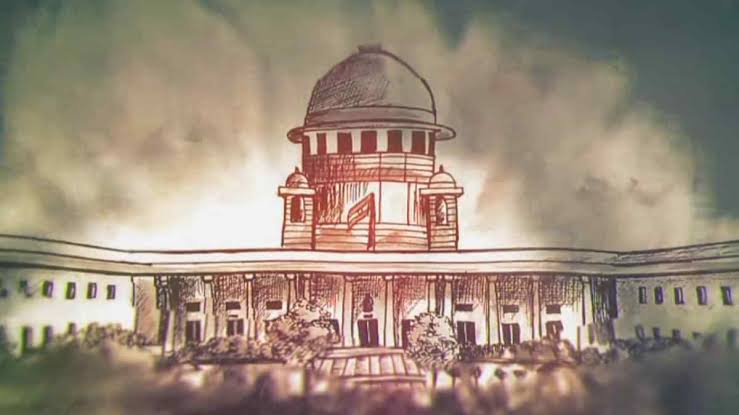
Closely examining the seriousness of the current situation, we see the country tussling in various aspects but the most horrifying aspect is that of the migrant workers in India. The Supreme Court which is supposed to protect the rights of the citizens have failed to do so. This not only questions the various tires of the judicial system but it jogs one’s attention directly to the search engine of the Indian Constitution. Dr. B R Ambedkar considered Article 32 as one of the most important institutional provisions- which allows the citizens to approach the Supreme Court against violation of their fundamental rights. But now the judges are missing upon this fact.
History of the Supreme Court
The Supreme Court serves both as the final court of appeals and the final interpreter of the Constitution. It is often regarded as the most progressive judicial bodies across the globe. Even though the entire country is in lockdown, judgments have been delivered in a total of 325 cases which include 268 connected matters. The quick adaption to the new virtual system is applauded by each law-abiding citizen of India. The Puttaswamy judgment which Made the right to privacy a fundamental right. Navtej Singh Johar v. Union of India which decriminalized homosexuality. In light of the above, it can be said that the Supreme Court over these years has largely governed by its endeavor to ensure that justice is done. The court has stood by its name but this did not happen overnight. After receiving a lot of criticism from the infamous ADM Jabalpur judgment. The Supreme Court has restored the faith of the people and has made them realized that the honest parties are not the ultimate sufferers and that the guilty are ultimately punished.
The fate of the petitions: Delayed and then dropped
The problem of migrant workers might not be unique to India, but some frightening incidents have shone a spotlight on the plight of millions of poor Indians- and how the lockdown has stranded them far away from home. We wake up every day to several disheartening pictures where the migrant workers are sleeping on roads and seem depressed. Over 120 of them have dies along their way. While the center set up a massive mission titled ‘ Vande Bharat’ to bring back the Indians marooned overseas. But it has not shown the same enthusiasm towards the migrant workers. Instead, it added more pressure and blame on the states.
In another writ petition which sought directions to help migrants get home, the Supreme Court initially called on the Centre to explain the steps it was taking for allowing movement of migrant workers to their hometowns. In the subsequent hearing, despite the petitioners throwing light on how the migrants were being forced to pay for their tickets still, the government’s law officer having no response on who was bearing the travel fate, the court disposed of the Petition on the ground that its jurisdiction was limited under Article 32 and that the main relief sought for had been considerably fulfilled.
How can questions with such a heartfelt effect on the delivery of justice be summarily dismissed as an internal matter? It is the constitutional right of every citizen to approach the courts especially the Supreme Court to enforce their rights. Therefore, it cannot be claimed that citizens do not have the right to know how decisions that affect justice are made.
A lesson from the past
During the 1975-77 emergency, approximately 1,00,000 people were detained under the detention law.10 high courts said that even when emergency rights were suspended, habeas corpus appeals were filed before the courts. and they repealed several orders for banned detention. It is regrettable that the Supreme Court bench reversed those decisions and stated that in an emergency even their applications for Habeas Corpus cannot be tolerated. Justice Khanna gave his famous dissent, though that led to his reinstatement as Chief Justice otherwise guaranteed him a permanent place in the history of justice. He reminded the court in the honor of Lord Atkins’ famous defense of the same issue that emerged in England during World War II, in Liversidge v Anderson, that they “acknowledge the conflict of arms that the rules are inflexible” and that the court’s action may approve. in an emergency, anvil should be tested for constitutional and human rights.
The odd conduct of the Supreme Court during the crisis was profoundly baffling. The sort of giving up of the Supreme Court that we are encountering today because of the COVID-19 emergency (even without an affirmation of crisis) is maybe considerably progressively genuine when the court isn’t set up to address practically whatever the administration has done or not done regardless of the grave encroachment of central rights that have followed.
High Courts dip a toe in
With the Centre ‘abdicating responsibilities’, the state governments were left within the lurch. Various High Courts have considered the seriousness of this issue and stood up to require all the responsibilities. The migrant worker crises were marked by empathy for his or her plight. Last month, the Himachal Pradesh High Court ordered the state government to file an action taken report on the steps taken to address the challenges being faced by migrant laborers. This order referred to an order passed by the Jammu and Kashmir High Court in March, directing the UT administrations of Jammu and Kashmir and Ladakh to ensure that “accommodation, healthcare and the needs of the migrant laborers, if not already provided for, are addressed”. The Karnataka judicature on May 12 ordered the governments to make your mind up on paying the transportation cost of the workers going back to their villages and city. province judicature while hearing a PIL said that ignoring the plight of the migrant workers will amount to the disrepair of duty and that we should act as a protector of the poor. Gujarat judicature has taken suo moto cognizance since many of them are dying of hunger. The Delhi judicature directed the Arvind Kejriwal government to make sure that there is an uninterrupted working of the helpline numbers founded to enable the return of migrant workers to their native place. In light of those shortcomings, various judicature directed the govt. to form awareness about the trains plying, to produce assurance and a schedule to the migrants who had registered to travel back to their home.
Conclusion
India is experiencing the worst large scale pandemic and that we don’t have any reliable data to inform us when the pandemic will end. The lockdown was necessary and nobody is blamed for the identical. But as a democratic country we should always raise our concern regarding the recent wireless silence attitude of the Supreme Court. Corona may be a rousing demand for all Indian Courts especially the Supreme Court. It’s a golden opportunity for the judiciary to persuade the hearts of the people by taking proactive steps. in step with the Supreme Court lawyer Dushyant Dave, “I do believe that the judiciary’s prime responsibility is adjudication, which is becoming longer, and so, more painful. The judiciary should target adjudication and not stray into the chief or legislative field.” The Supreme Court, incorrectly presenting itself as having to decide on between complete restraint or absorbing the Executive’s role, is falling far wanting the expectations that not only the Constituent Assembly but every citizen had from it. If the judiciary’s conscience is dead the lawyers must awaken the conscience.
 lawtheline.law.blog
Very true
LikeLike
Thank you.
LikeLike
Agree
LikeLike
This is debatable issue. When country has declared lockdown then all worker shall also follow the same.
Then too govt has arranged trains. But now covid will spread in small towns also where facilities are not there.
LikeLike
The synopsis of my article is how the Supreme Court is handling the present crisis. The trains that are opened and the food and shelter that is provided to them was done by the state governments( order being given by the High Courts). Supreme Court has been rejecting an ample number of writ petitions which infringe the fundamental rights. My opinion is that the Supreme Court is the apex chamber of our country at this time of the crisis it should not remain silent but instead take proactive actions.
LikeLike
Very well Said 👍
LikeLike
Thank you!
LikeLike
If as per this article 32 fails to serve the purpose intended by its creator than you are forgetting that article 42(uniform civil code) which states that uniform civil code should be applied across the country but is it truly implemented?? NO. My whole point is that u can’t blame the Supreme Court or the law markers or the decision chambers of the country something or maybe most of the thing depends on also the people running the country n the citizens of then country about how they take it. It’s not that easy to make a judgment on a petition. Also to bring to your notice ayodya judgment also took a whole more than 20 years so its not that easy
LikeLike
For starters, I did not blame the law-makers of the constitution. My whole point was that the high authority lawyers are missing out on the importance as far as Article 32 of the Indian constitution is concerned. Talking about UCC which is altogether a different provision in the Indian Constitution and has no relevance with the synopsis of this article. Also, UCC is stated under “article 44” of Directive Principles of State Policy. However, as clarified by A-37, directive principles are not enforceable by any court, although they are fundamental in the governance of the country. Whereas, the lawmakers have considered article 32 to be of great importance and very well enforceable. So, there are no grounds for comparing both of them.
If you are well versed with all the news pertaining to this topic, dozens of writ petitions, PILs were dismissed by the Supreme Court even without hearing it. I have also included one of them in my article. I don’t deny the fact that it’s not easy to make a judgment but at least proactive steps should have been taken.
The whole country is going through a pandemic. Ayodhya judgment is not something where the entire nation was experiencing a crisis.
I have not at all blamed the Supreme Court without any proper research. Furthermore,it is my opinion supported by concrete facts. For more clarity, you can kindly refer to
https://timesofindia.indiatimes.com/india/did-a-late-night-letter-from-20-senior-lawyers-change-sc-mind-on-migrants/articleshow/76020829.cms
Thank you.
LikeLike
Very true and perfect naman shah
LikeLike
Yes sry article 44, but if u can interpret the directive principle states that the state shall endeavor n its an obligation n not an option also if u can understand this article it is not only violating article 44 but also article 14,15 which gives equal right to all citizens throughout the courtry. Today bcoz of no Ucc there is no quality let’s not get into more of that but my point is rather than blaming the judicial bench for the HOT TOPIC it would be better to question them for a topic which is in existence from decades
LikeLike
Yes sry article 44, but if u can interpret the directive principle states that the state shall endeavor n its an obligation n not an option also if u can understand this article it is not only violating article 44 but also article 14,15 which gives equal right to all citizens throughout the courtry. Today bcoz of no Ucc there is no quality let’s not get into more of that but my point is rather than blaming the judicial bench for the HOT TOPIC it would be better to discuss these topics rather than the hot ones
LikeLike